"Border thinking or theorizing emerged from and as a response to the violence (frontiers) of imperial/territorial epistemology and rhetoric of modernity (and globalisation) of salvation that continues to be implemented on the assumption of the inferiority of devilish intentions of the Other and, therefore, continues to justify oppression and exploitation as well as eradication of the difference." (206)
"Critical border thinking' instead is grounded in the expereinces of the colonies and subaltern empires." (206)
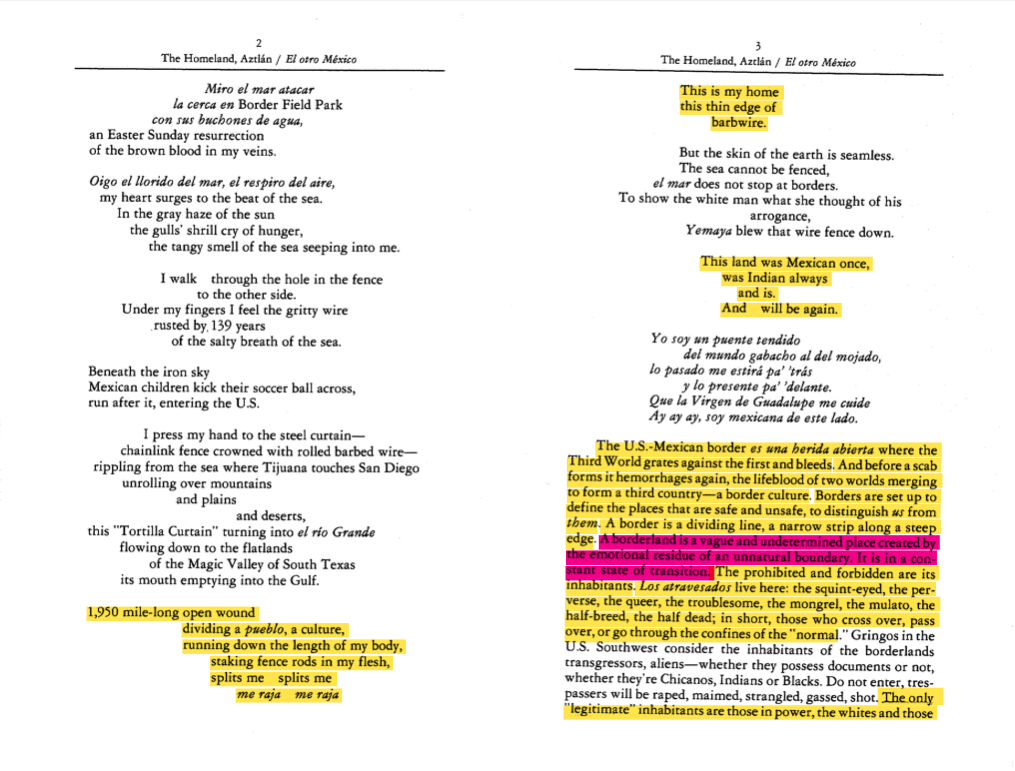
"'Borders' are the not only geographic but also political, subjective (for example cultural) and epistemic and, contrary to frontiers, the very concept of 'border' implies the exsitence of people, language, religions and knwoledge..." (208)
"Borders in this precise sense, are not a natural outcome of a natural divine historical process in human history, but were created in the very constitution of the modern/colonial word." (208)
“But to delink is not to abandon, to ignore.” (218)
“No one could abandon sedimentation of imperial languages and categories of thought.” (218)
“Border thinking proposes how to deal with that imperial sedimentation while at the same time breaking free of the spell and the enchantment of imperial modernity.” (218)
Deadspace: a space considered to be barren, inactive, insignificant and subsequently invisible, and yet at the same time very much rich in culture.